Examples
Two projects, planned backward.
Both of these are real plans built in InControl, and every screenshot below is the app rendering them — no mockups, no invented numbers. Read them as stories, or as how-to guides for the same project in your own life.
Case study one
Plan a destination wedding
Sixty guests, one road into town, and a foreign country's paperwork between you and being married. The Rivera–Chen wedding at Hacienda Sac Nicte, Tulum — ceremony at 4:30pm on December 29.
Dec 29
The date everything moves around
$57,300
Budget, across 7 phases
162 days
From the first task to the ceremony
60
Guests flying internationally
The goal
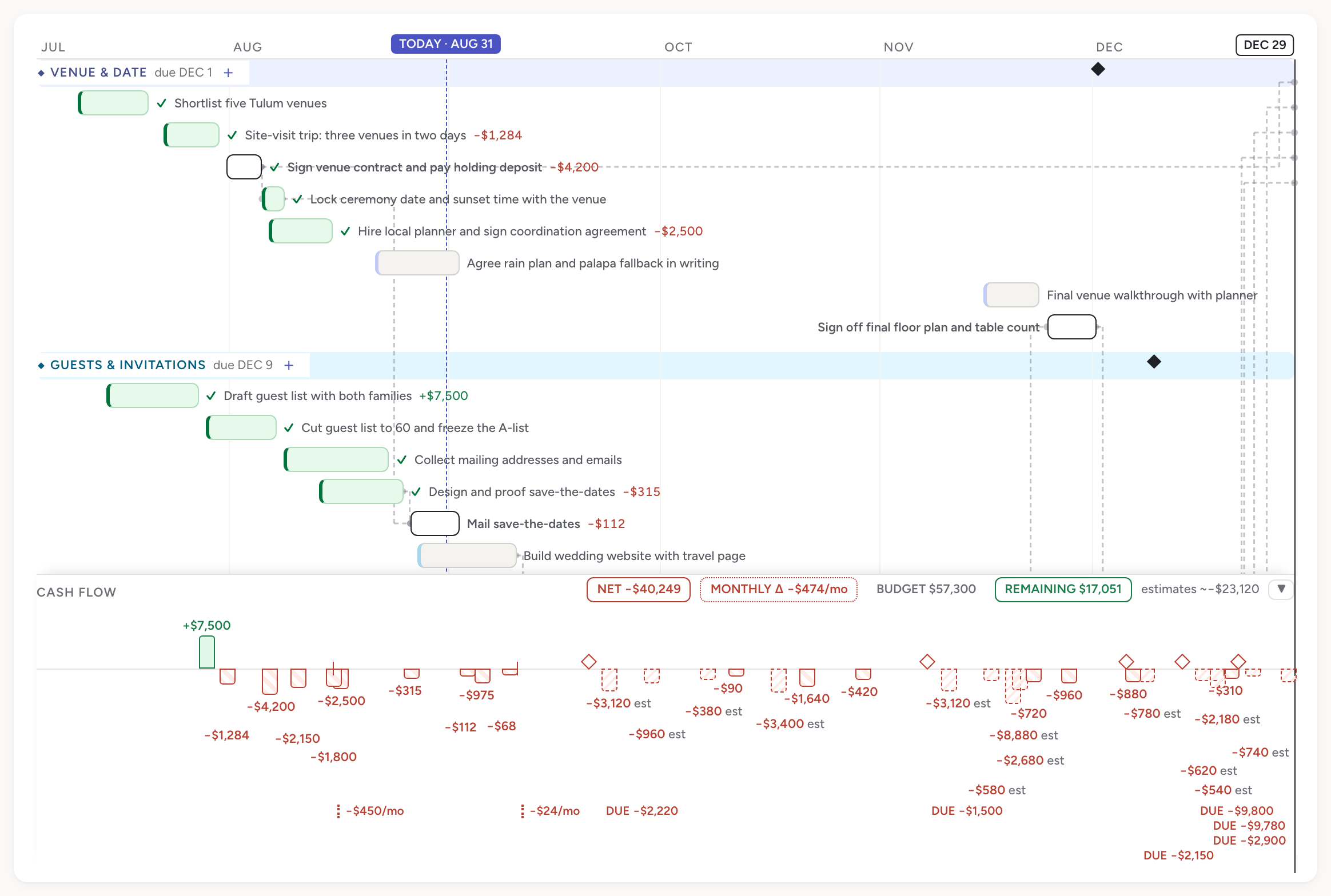
The project has exactly one goal and it is not "have a wedding". It is "Ceremony at 4:30pm, Hacienda Sac Nicte" on a named day. Everything else in the plan is derived from that: InControl schedules backward, so the question it asks about every task is not "when would you like to do this?" but "how late can this start and still be finished in time?"
That reframing is what makes a destination wedding tractable. A dress with a sixteen-week production run is not a shopping trip, it is a deadline 142 days before the ceremony. Three fittings across eight weeks is not a preference, it is the atelier's clock, and the plan carries it as a chain: dress arrives → first fitting → second → final fitting and pickup → hand-carry it onto the plane.
The plan
Seven phases, sequenced by what blocks what. Venue & Date comes first because it is the only decision no other vendor will work around — nobody quotes a photographer's day rate for a date that is not held. Signing the venue contract unlocks locking the ceremony date and sunset time, which unlocks mailing the save-the-dates.
From there the guest chain runs the length of the project and every link is real: save-the-dates go out early because people are booking international flights; invitations follow, but only after the wedding website with the travel page exists, because the invitation points at it; the RSVP window opens; non-responders get chased by phone; and only then can the final headcount be locked and sent to the caterer. Headcount then unlocks three separate things — the seating chart, the final floor plan and table count, and (through the floor plan) the florist's order quantity. Cut the guest list late and you have not made one change, you have made four.
The legal thread is the one that actually frightens people, and it is the one backward planning is best at. Certified birth certificates → state apostille → certified Spanish translation by a state-registered perito traductor → Registro Civil appointment. Four steps, in that order, each of which can only start when the previous one lands, with realistic lead times of two to five weeks apiece. Started late, it is a cancelled ceremony. Started 112 days out, it is admin.
And then the constraint that cannot be pulled forward at all: blood work at an approved Tulum lab, valid for 15 days. It cannot be done at home in advance, so it sits seven days before the ceremony and nowhere else. A plan that runs forward from today will happily let you book it in October. A plan that runs backward from the date knows it has a window and puts it in the window.
Decisions get written down where they were made
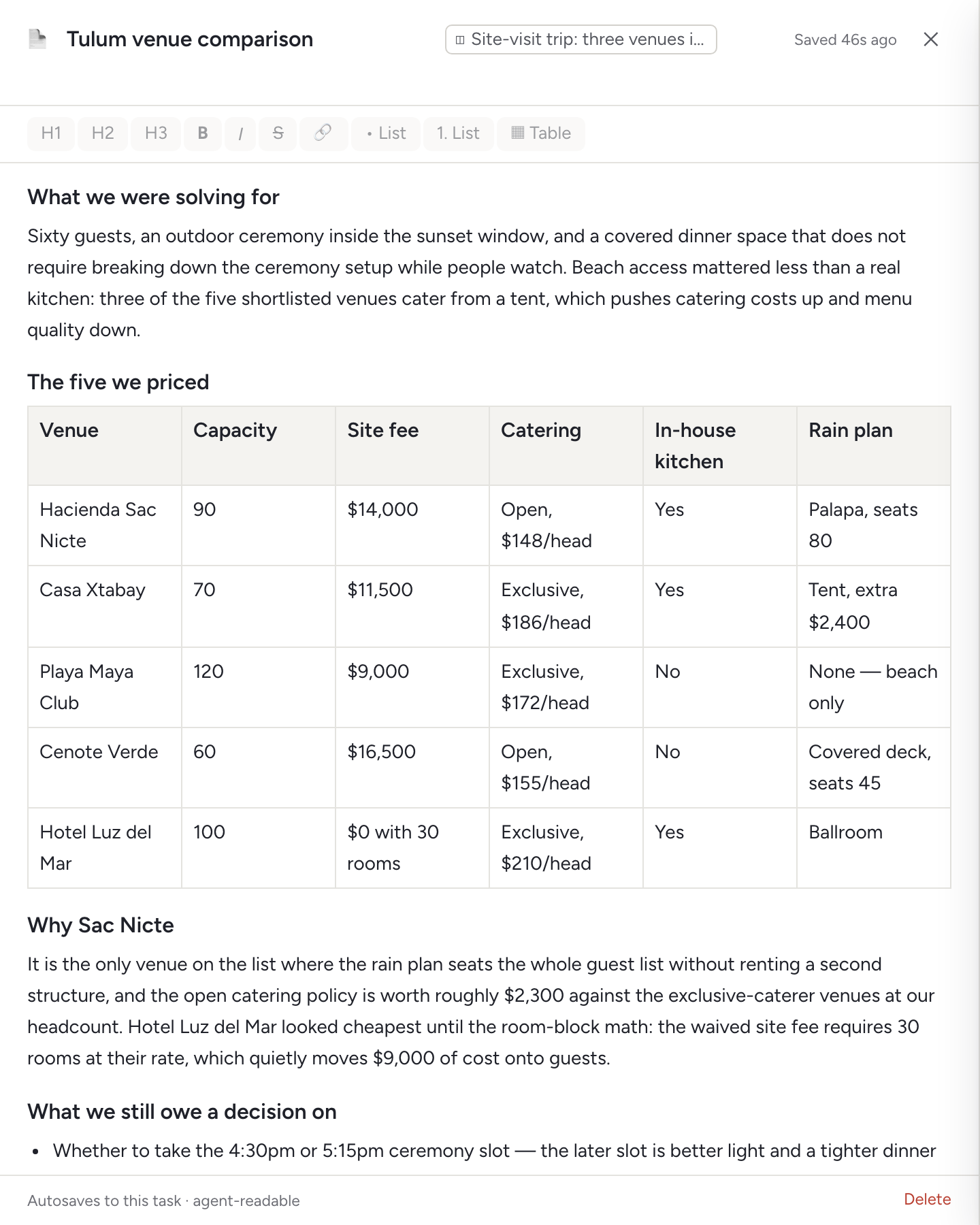
Five venues, priced side by side, attached to the task that priced them. The research is not the point — the reasoning is. Hotel Luz del Mar looked cheapest until the room-block math: a waived site fee that requires 30 rooms at their rate quietly moves $9,000 of cost onto guests. Six months later, nobody has to reconstruct why Sac Nicte won.
The money
A wedding budget is not a number, it is a schedule. Almost nothing is paid once: deposits and balances come in pairs, months apart, and the balances all crowd into the last fortnight. The venue is −$4,200 as a 30% holding deposit at signing and −$9,800 as a balance fourteen days out. The photographer is −$1,800 then −$2,900. The caterer is −$2,220 on contract and −$9,780 once the headcount is final — which is why "lock the headcount" is a money task, not an admin task. The DJ, the dress, the room block all work the same way.
Money that arrives is on the same strip: a +$7,500 gift from the Chen family toward the venue, and a +$5,000 pledge from the Riveras still marked as an estimate, because a pledge is not a deposit. Recurring costs sit there too — the planner's −$450/mo coordination fee, −$24/mo of wedding website and photo hosting — so the monthly drift is a number you chose rather than one you find on a statement.
The honeymoon is the honest part. Ten days in Oaxaca, priced and shortlisted but deliberately unbooked: flights, hotel and excursions all carry estimate marks until the wedding balances clear and there is a real number left. InControl draws estimates as dashed outlines, so you can see at a glance how much of your plan is a fact and how much is still a guess.
And a plain spreadsheet, when a spreadsheet is what you want
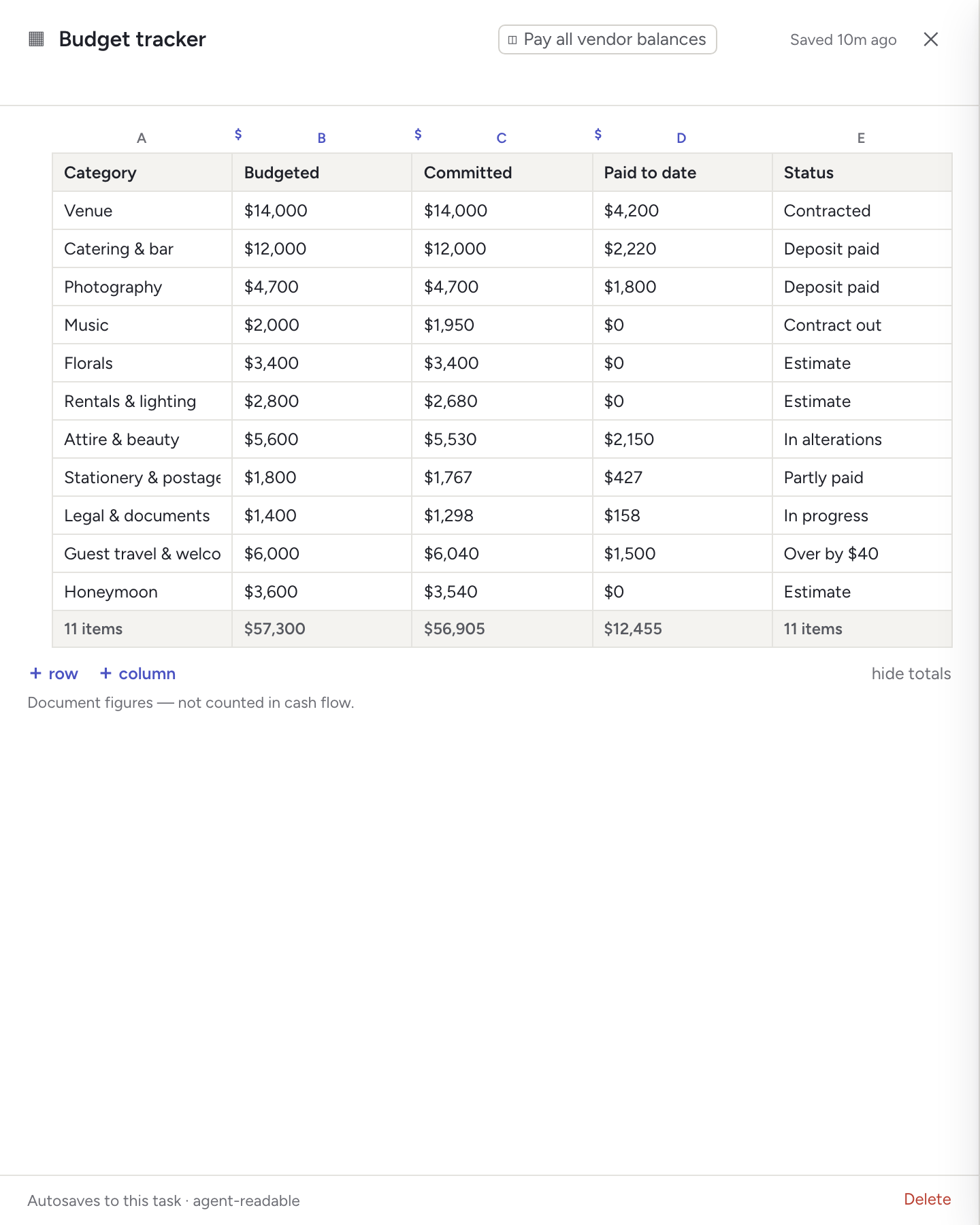
Not everything wants to be a task. A sheet lives on the task it belongs to, does its own arithmetic, and is honest about its status: these are document figures, deliberately not counted in the project's cash flow, so the budget you are reconciling against never double-counts itself.
One task, everything it touches
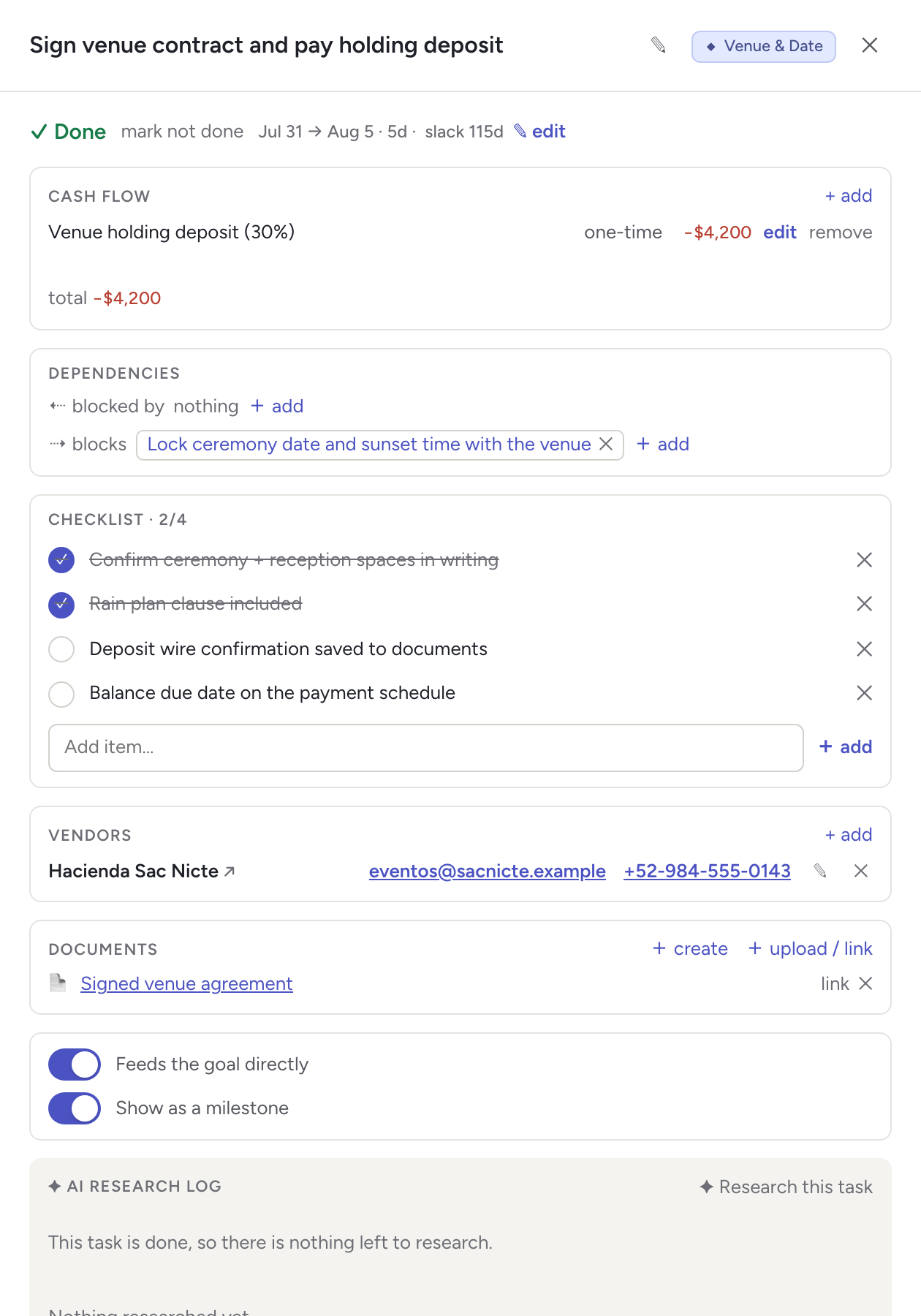
Open any bar on the timeline and the whole context is there: the −$4,200 that leaves your account, what it blocks downstream, the four-item checklist you wrote when you were paying attention, the venue's email and phone, and the signed agreement itself. No hunting through a separate folder, a separate spreadsheet and a separate inbox to answer one question.
Where the AI helped
In three specific places, and not in the fourth you might expect. It drafted the structure: given "wedding in Tulum, December 29, sixty guests, $57,300", it proposed the seven phases and the work inside them, sized and sequenced, before a single task was typed. That draft was wrong in places — it always is — and it was far faster to correct than to author.
It ran the research passes that produced the venue comparison and the Quintana Roo marriage-requirements brief, with sources listed at the bottom of each so the claims can be checked rather than trusted. And when the schedule tightened, it flagged the risk and proposed a fix rather than quietly applying one.
What it did not do was make the decisions. The 4:30pm versus 5:15pm ceremony slot is still an open question in the venue document, written down as an open question. That is the shape of it: the AI does the legwork and the arithmetic, you keep the judgment.
Every phase knows what it costs and what is left
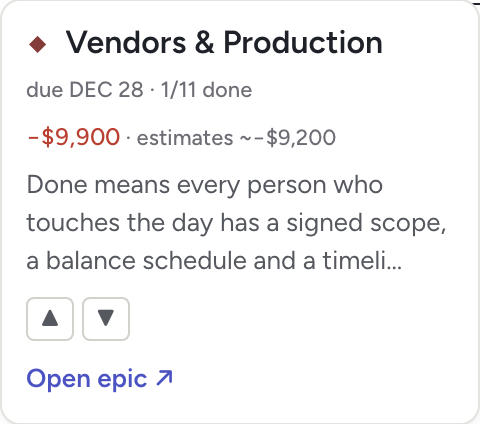
Phases carry their own due date, their own progress and their own money. Vendors & Production is due the day before the wedding, is 1 of 11 done, has −$9,900 committed and roughly another −$9,200 still sitting in estimates. That last number is the one that tells you whether you are actually on budget.
Case study two
Move a family across the country
Portland to Raleigh, 2,800 miles, two kids, one dog, and a school system that does not care when your house sells. The goal: keys handed over in Portland, family sleeping in Raleigh — the same day.
$38,000
Budget, across 7 phases
2 threads
Sell the house · rent, then buy
~5 weeks
Of deliberate double housing
60 days
To convert NC licences and plates
The goal
One date, two threads that have to arrive at it together. Thread one is selling the Portland house: agent, pre-inspection, repairs, paint, declutter, staging, photos, listing, open houses, offer, buyer inspection, appraisal, close. Thread two is Raleigh housing, and the decision that shapes the whole project is that it is rent first, buy later. Buying sight-unseen from 2,800 miles into an unfamiliar market is how families end up in the wrong school zone, so a twelve-month lease buys a year of local knowledge — and, just as importantly, takes the closing-date dependency off the sale.
The purchase search is not cancelled. It is scheduled: alerts set up, paused until month six.
The plan
The sell thread is a straight chain and it is unforgiving in one direction — repairs before staging, staging before photos, photos before the listing goes live, because the listing photos are the product. Slip the repairs and you have not slipped a week of repairs, you have slipped the listing, the offer window and the close.
The immovable date belongs to the school thread. Wake County assigns by address, with a magnet application on top, and both require proof of residency in a parent's name — a lease or a utility bill, not a signed offer letter. So signing the lease is not a housing task with a school consequence, it is a school task that happens to involve a lease, and the plan draws it that way: lease signed → magnet application filed, lease signed → both kids registered, lease signed → utilities on. The magnet window has no late option for out-of-county applicants. Miss it and the year is decided for you. North Carolina then gives you 30 calendar days from enrollment for the immunisation record and health assessment — another clock that starts on somebody else's signal.
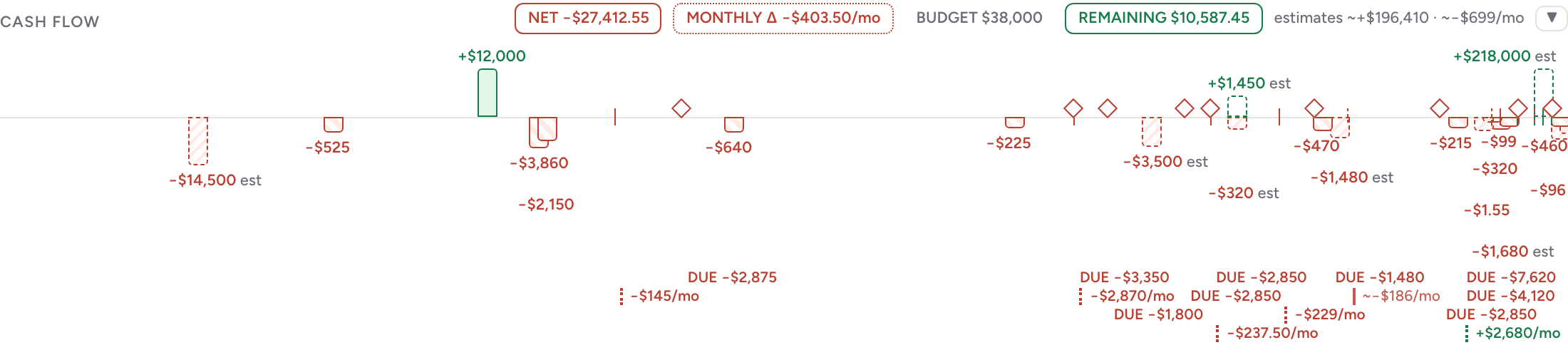
Utilities are where a move quietly costs money, so every service is two entries rather than one: an off date in Oregon and an on date in North Carolina. Portland electric, water and gas close out the day after closing; Duke Energy, City of Raleigh water and PSNC come on the day before the truck arrives; the fiber install is scheduled three days ahead of delivery, because a family of four in an empty house without internet is its own kind of emergency. On the timeline those are recurring entries, positive when a bill ends and negative when one starts — which is how the strip tells the double-housing story out loud instead of hiding it.
The rest is sorted by what can be replaced. Furniture is a cube estimate and a ship/store/sell column — the garage and the patio are sold, the dining room and basement go into a Raleigh 10×20 climate unit at −$229/mo. The second car is shipped, not driven, because two adults, two kids and five days in one vehicle is not a saving. The records — transcripts, immunisations, dental, the dog's health certificate — are their own tasks, because "we'll get those later" is how a first day of school gets missed.
The money
Two housing costs run at once and the plan says so in advance. The Raleigh lease starts before the Portland house closes: rent at −$2,850/mo begins, the first month lands as an overlap payment 45 days out, and the Portland mortgage does not stop until closing — where it shows on the strip as +$2,680/mo, a recurring cost ending, which is the honest way to draw relief. Two storage units overlap for about three weeks. Utilities double for about two. Roughly $3,600, chosen on purpose: the alternative is timing the lease to the closing and living in an extended-stay hotel with two kids and a dog if the sale slips, which costs more and is worse.
The big numbers are deposit-and-balance pairs again. The mover is −$1,800 at booking and −$7,620 on delivery, against a binding not-to-exceed quote. The rental is −$3,350 of deposit and pet fee at signing. Seller closing costs are −$4,120, the buyer's negotiated repair credit is −$3,500, and the listing commission is an estimate until the sale price is real. Against all of that: +$12,000 of relocation stipend, +$1,450 estimated from the estate sale, and the +$218,000 estimated net proceeds that make the arithmetic work.
Where the AI helped
Most usefully on the school question. A research pass turned Wake County's assignment rules, magnet lottery and residency-proof requirements into a comparison of four zones — base elementary, base middle, magnet availability, and the catch in each, with sources listed. That is the document that produced the plan's central insight: the rental address is a school decision, not a housing decision.
It did the same for the movers, and the finding was worth real money: of three quotes, the cheapest headline price was a non-binding estimate from a broker with 41 complaints in 24 months and released-value protection paying 60¢ a pound — about $48 for a $1,400 dishwasher. The plan books the binding not-to-exceed quote instead, and the task carries the condition that the not-to-exceed clause has to appear on the bill of lading, not just the estimate.
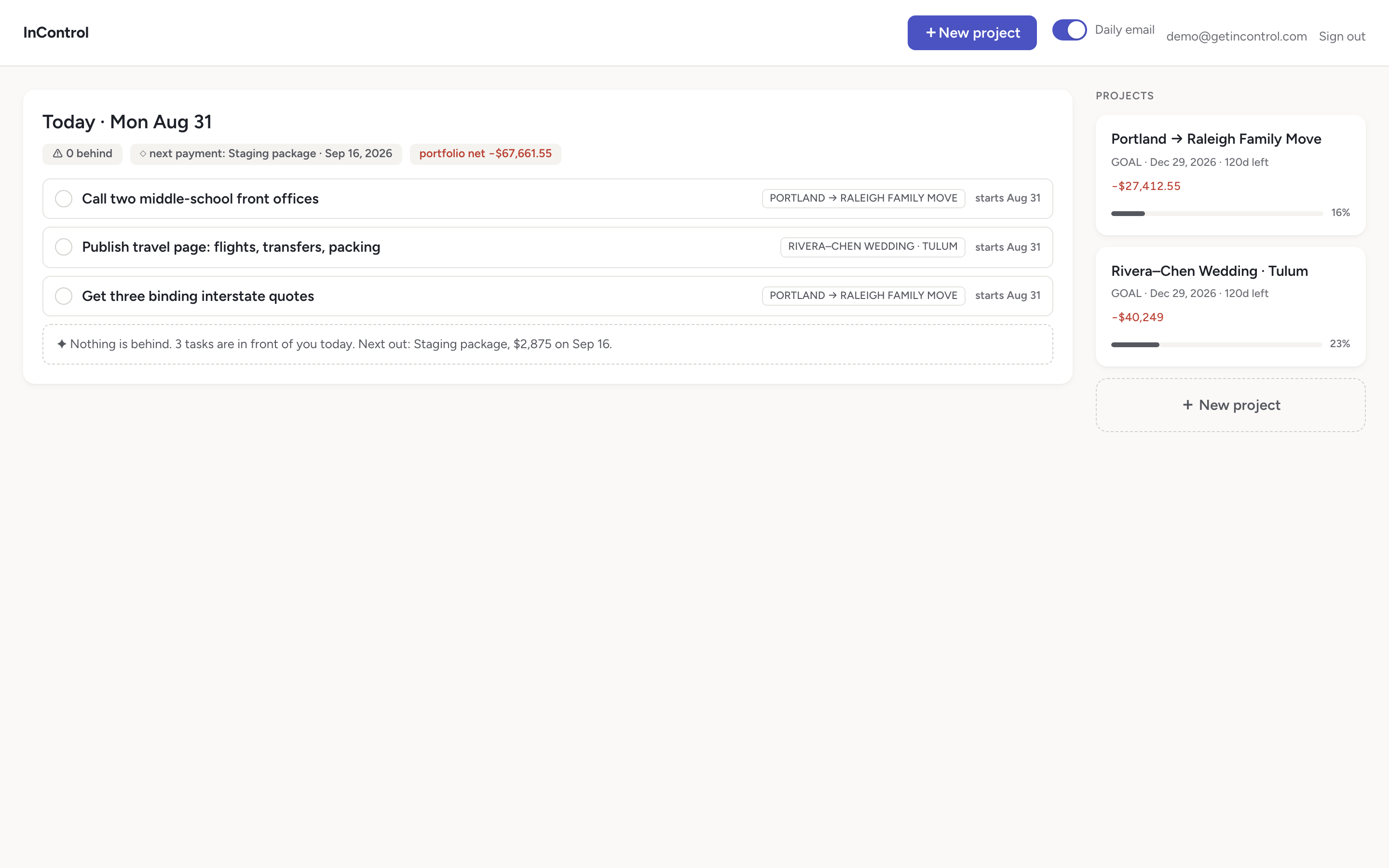
Day to day the thing that keeps the plan honest is smaller and needs no model at all: the dashboard and the daily email are composed from your own rows, so "nothing is behind" is arithmetic rather than reassurance.
Your turn
Different project, same method
Copy the shape of either plan, or start from your own date and let InControl propose the rest. Everything shown above is live in the product today; the only thing still coming is paid billing. See pricing.
A renovation
Permits before trades, trades in the order they can work in.
Opening a business
Licences, fit-out and stock all landing on the same morning.
A new baby
A due date is the most immovable deadline there is.
Emigrating
Visas, shipping and schools, each on somebody else's clock.